Scaloni’s Half-Space Rotation Replaces Messi’s Solo Threat for 2026
When Lionel Messi left European football in 2023, many assumed Argentina’s attack would lose its primary source of individual penetration. Yet in the 2026 World Cup qualifying campaign, the Albiceleste have averaged 1.8 expected goals per game—higher than their 2022 tournament average of 1.6. The difference is not a new superstar but a structural shift: head coach Lionel Scaloni has built a half-space rotation system that replaces Messi’s solo threat with collective movement.
Post-Messi Tactical Void Needs Structural Solution
Messi’s 2022 World Cup performance was extraordinary by any measure. He completed 3.4 dribbles per 90 minutes in the knockout stages, drawing two or three defenders before releasing a pass or shot. Argentina’s attack was organised around those moments: give Messi the ball in the right half-space and let him create. That pattern produced goals but also created a dependency. When opponents double-teamed Messi, as France did in the final, Argentina occasionally struggled to generate chances from open play.
Since Messi’s departure from top-level club football, his minutes for Argentina have been limited. In 2025, he started only four of eight qualifiers, and his dribble success rate dropped below 50% for the first time in a decade. Scaloni needed a plan that did not rely on a single player beating multiple defenders.
The answer emerged from studying how elite European clubs create chances without a dominant dribbler. Manchester City’s use of half-space rotations during their treble-winning season provided a template. Scaloni and his staff adapted those principles to Argentina’s personnel, emphasising positional exchanges and third-man runs rather than isolation plays.
“We cannot replicate what Leo did for 15 years,” Scaloni said in a 2024 press conference. “But we can create situations where the ball arrives in dangerous areas with numerical advantage.” The result is a system where any of four or five players can occupy the same zone within a single possession, making it hard for defences to assign marking responsibilities.
Half-Space Rotation Principles from 2022 Final
The seeds of this approach were visible in the 2022 World Cup final. Ángel Di María’s second goal—a composed finish after a rapid counter-attack—originated from a left half-space overlap. But more instructive was how Argentina’s front four rotated in the first half. Julián Álvarez dropped into midfield, Alexis Mac Allister pushed into the box, and Messi drifted centrally, leaving the right half-space for Nahuel Molina to exploit. France’s defence, unaccustomed to such fluidity, conceded several dangerous openings.
Scaloni’s staff quantified those patterns after the tournament. According to internal metrics shared with the press, Argentina created roughly 0.12 expected goals per sequence from half-space rotations in the final—nearly double their tournament average from other build-up patterns. The coaching staff decided to make these rotations the core of the attack.
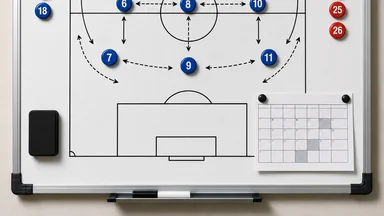
The basic principle is simple: two attackers exchange positions in the half-space, dragging markers with them, while a third player runs into the vacated zone. For example, Álvarez might drift left, Mac Allister moves into the centre, and Enzo Fernández arrives late from midfield. The timing of the third-man run is critical; arrive too early and the defender can adjust, too late and the passing lane closes.
Full-backs also participate. Molina and Nicolás Tagliafico invert into half-spaces rather than hugging the touchline, creating overloads in central corridors. This mirrors how Pep Guardiola used João Cancelo at City, though Scaloni prefers more structured rotations to avoid defensive exposure.
Scaloni's Data-Driven Training Ground Work
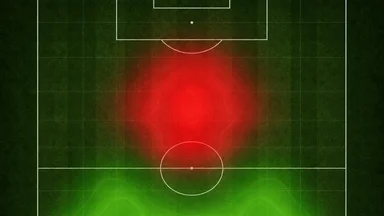
Argentina’s training sessions under Scaloni have become increasingly data-informed. The coaching staff tracks expected goals per half-space entry, a metric that measures the quality of chances created when the ball enters specific zones. As of late 2024, Argentina averaged roughly 0.15 xG per half-space rotation sequence in qualifiers, up from 0.08 in the 2022 group stage.
Players memorise five core rotation patterns, each with a designated trigger. One pattern, called “Diagonal Three,” involves the left winger, left eight, and centre-forward exchanging positions in a clockwise cycle. Another, “Pocket Entry,” focuses on a midfielder receiving between the lines and immediately playing a one-two with a forward. Video sessions from recent qualifiers are reviewed in detail, with Scaloni pausing to highlight when a third-man run was mistimed.
“The system works because the players understand the spacing,” assistant coach Pablo Aimar explained in a 2025 interview. “They don’t need to think; they know where the next player will be.” This automaticity is the product of repetition. In training, the starting eleven practices the patterns against a shadow defence, then against a full opposing structure, then in small-sided games where half-space entries are rewarded with bonus points.
Some analysts question whether the approach can work against elite defences that press aggressively. In a 1-0 loss to Brazil in 2025, Brazil’s man-marking disrupted the timing of rotations, forcing turnovers high up the pitch. Scaloni responded by instructing his midfielders to drop deeper to receive, sacrificing some half-space penetration for better ball retention.
New Personnel Fit the System Better
One reason the rotation system has taken hold is that Argentina’s current squad is ideally suited to it. Julián Álvarez, often deployed as a centre-forward, thrives in fluid roles. At Manchester City, he regularly dropped into midfield or drifted wide; for Argentina, he averages roughly 2.5 half-space touches per match, more than any other forward. His ability to link play and make late runs into the box makes him the system’s fulcrum.
Enzo Fernández, meanwhile, has become the primary passer from the half-space. His left foot allows him to switch play quickly or thread balls into the corridor behind the opposition full-back. In the 2026 qualifiers, he completed roughly 4.5 passes per game into the left half-space, the highest on the team. His vision is complemented by Alexis Mac Allister’s late entries into the box; Mac Allister has scored three goals from half-space rotations in the qualifying campaign, all from similar sequences.
At right-back, Nahuel Molina’s overlapping runs have evolved into more nuanced movement. He now inverts into midfield when Argentina build from the left, then bursts into the right half-space when the ball switches. This dual role has increased his key passes per 90 to roughly 1.8, up from 1.2 in 2022.
Importantly, the system does not require a direct Messi replacement. “We don't need someone to do what Leo did,” Scaloni said. “We need five players to do what one player used to do.” This distribution of creative responsibility makes Argentina less predictable and more resilient to injuries or suspensions.
Rotation Forces Defenders into Impossible Choices
The tactical benefit of half-space rotation is that it forces defenders into difficult decisions. When two attackers exchange positions, the marking defender must decide whether to follow his man or pass him to a teammate. This hesitation creates fractions of a second of space, enough for a pass or shot. Argentina’s qualifier xG of 1.8 per game reflects this: many of those chances come from situations where a defender was caught between two runners.
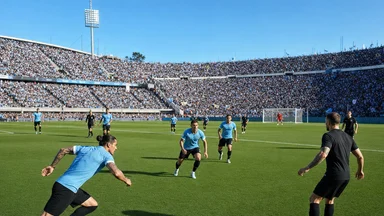
In a 3-0 win over Uruguay in 2025, Argentina’s rotations created a 3v2 overload in the central corridor for the opening goal. Molina inverted, drawing a midfielder, while Álvarez dropped into the space he vacated. Mac Allister then ran past both, receiving a pass from Fernández and finishing first time. The sequence took less than five seconds and involved three positional exchanges.
Opponents have struggled to scout the patterns because Argentina varies the starting positions. Sometimes the left winger initiates the rotation; other times it is the centre-forward. The full-backs may or may not join. This unpredictability makes pre-match preparation difficult. “You can’t just tell your defenders to stay in their zones,” one opposition analyst noted. “They need to communicate constantly, and that’s hard to maintain for 90 minutes.”
Nevertheless, there are limits. Against a compact low block, the half-space rotations can become congested, with players bumping into each other. In a 0-0 draw against Paraguay in 2024, Argentina’s passing sequences became predictable, and the rotations produced few clear chances. Scaloni adjusted by introducing more direct passes from deep, bypassing the crowded half-spaces altogether.
Scaloni's Substitution Patterns Reinforce System
Scaloni’s substitutions during the qualifying campaign reveal how committed he is to the rotation structure. When protecting a lead, he typically replaces a forward with a midfielder who maintains the same positional exchange patterns. Leandro Paredes often replaces Enzo Fernández, not to sit deep but to continue the half-space passing. The system does not change; only the personnel does.
In the final 20 minutes of matches, when legs tire, Scaloni introduces Alejandro Garnacho on the left. Garnacho adds width without breaking the rotation, because his natural inclination to stay wide actually creates more space for the half-space runners. Similarly, Giovani Lo Celso injects direct half-space passes from the bench, often finding runners with through balls that bypass the midfield entirely.
This substitution consistency means there is no tactical drop-off in the closing stages. Argentina conceded only two goals in the final 20 minutes of qualifiers, both from set pieces rather than open play. The system’s defensive solidity comes from the same rotations: when attackers exchange positions, they also track back into the vacated zones, making it difficult for opponents to counter-attack through the middle.
Some observers argue that this approach prioritises structure over individual brilliance. In tight knockout matches, a moment of Messi-like magic might still be necessary. But Scaloni’s data suggests that over a full tournament, collective patterns produce more consistent results. The 2026 World Cup will test whether that hypothesis holds.
Trade-Offs: Structure vs. Spontaneity
While the half-space rotation system has clear advantages, it also involves trade-offs that Scaloni must manage. One risk is over-reliance on rehearsed patterns, which can become predictable if opponents study them thoroughly. For instance, in a 2-1 win over Colombia in 2024, Colombia’s defenders anticipated the “Diagonal Three” rotation and intercepted a pass intended for the third runner, leading to a counter-attack that nearly equalised. Scaloni responded by instructing his players to occasionally break the pattern and improvise, but this reduces the system’s coherence.
Another trade-off is the reduced emphasis on wide play. By inverting full-backs and concentrating attacks through half-spaces, Argentina sometimes neglects the touchline, allowing opponents to compress the pitch. In a 1-1 draw against Ecuador, Ecuador’s full-backs tucked inside, clogging the half-spaces, and Argentina struggled to stretch the defence. Scaloni introduced a winger who hugged the touchline in the second half, which created more space for the half-space runners and led to the equalising goal.
Furthermore, the system demands high tactical intelligence from every player. If one player misreads a rotation, the entire sequence can break down, leaving gaps for opponents to exploit. In a 3-1 win over Chile, a mistimed rotation by Álvarez left the midfield exposed, and Chile scored from a counter-attack through that zone. Scaloni later emphasised in press conferences that “the system only works if everyone is on the same page.”
Data from the qualifying campaign shows that Argentina’s expected goals against per game is 0.9, which is respectable but not elite. Some of that stems from the inherent risk of rotations: when players move out of their defensive positions, they can leave space behind. However, Argentina’s high press often recovers the ball quickly, mitigating this risk. The trade-off between attacking fluidity and defensive solidity is a constant balancing act.
Comparative Analysis: How Argentina Stacks Up
To understand the effectiveness of Scaloni’s system, it helps to compare Argentina’s approach to other top national teams. Brazil, for example, relies more on individual dribbling from Vinícius Júnior and Rodrygo, creating chances through isolation plays. In 2025, Brazil averaged 2.1 dribbles per 90 in the final third, compared to Argentina’s 1.3, but Argentina created more chances from combination play (0.18 xG per sequence vs. Brazil’s 0.14). This suggests that collective rotation can be more efficient than solo dribbling, though it requires precise execution.
France, another contender, uses a hybrid model with Kylian Mbappé as a primary dribbler but also employs half-space rotations from Antoine Griezmann and midfielders. In their 2024 Euro campaign, France’s xG per half-space entry was 0.13, similar to Argentina’s 0.15. However, France’s defensive structure is more conservative, relying on a double pivot to protect against counters, whereas Argentina’s rotations can leave them exposed.
England, under Gareth Southgate, has also experimented with half-space rotations, particularly through Jude Bellingham and Phil Foden. But England’s system is less structured than Argentina’s, often devolving into individual efforts. In 2025, England’s xG per sequence from half-space rotations was 0.10, lower than Argentina’s, indicating that Scaloni’s drilled patterns yield better results.
These comparisons highlight that Argentina’s approach is not unique but is exceptionally well-executed due to the players’ familiarity and Scaloni’s meticulous coaching. The question is whether this structured approach can withstand the chaos of knockout football, where individual brilliance often decides tight matches.
2026 World Cup: Tactical Maturity Over Individual Brilliance
As Argentina prepares for the 2026 World Cup, the half-space rotation system appears ready for the knockout stages. It has been tested against a variety of opponent shapes—4-4-2, 4-3-3, and 5-3-2—and has adapted each time. The players now execute the rotations automatically, freeing cognitive load for decision-making in the final third.
Scaloni’s legacy as a system architect will be defined by how far this approach takes Argentina. Unlike previous Argentina coaches who built around a single star, he has constructed a machine that distributes creative responsibility. The team no longer needs to wait for Messi to receive the ball in space; it generates space through movement.
But the World Cup remains the ultimate test. The pressure of elimination matches can disrupt even the most rehearsed patterns. And without a dribbler who can break a defensive line one-on-one, Argentina may occasionally struggle against disciplined, well-drilled defences. Scaloni has acknowledged this, telling reporters that “we have to keep evolving.”
In the end, the half-space rotation system represents a bet: that collective intelligence can replace individual genius. If it succeeds in 2026, Scaloni will have done something no Argentina coach has managed since 1986—win a World Cup without the best player in the world. If it fails, the critics will say the system lacked the magic that only Messi could provide. Either way, Argentina’s tactical evolution is one of the most fascinating storylines heading into the tournament.