FIFA's 2026 Ball-Tracking Mandate Removes Subjective Offside Decisions
The 2018 World Cup semifinal between France and Belgium featured a moment that still sparks debate: Antoine Griezmann's free kick led to a goal, but replays suggested that the ball may have touched a Belgian defender before reaching Samuel Umtiti. Offside was not an issue there, but the incident highlighted how reliant decisions are on human judgment. More famously, in the 2022 World Cup, Japan's second goal against Spain was allowed after a marginal offside check that took over two minutes, with the ball appearing to have gone out of play. Those calls, replayed endlessly on broadcasts, have sparked debates that linger long after the final whistle. At the 2026 FIFA World Cup, that era will effectively end. FIFA has mandated the use of semi-automated offside technology (SAOT) for all matches, a system that replaces subjective freeze-frame selection with real-time ball-tracking and skeletal player data. The change is not incremental; it is structural, removing the most controversial element of VAR from human hands.
The 2026 Rule Change That Eliminates the Human Guess
FIFA's 2026 mandate requires all host stadiums to install the infrastructure for semi-automated offside technology. The system combines two core components: a connected ball that transmits its position 500 times per second, and 12 dedicated cameras that track 29 body points on each player. When a pass is played, the ball chip records the exact moment of contact. Simultaneously, the cameras triangulate the limb positions of every attacking and defending player. An algorithm then generates a 3D offside line on the video feed within seconds, flagging any attacker whose body part—other than arms or hands—is beyond the second-to-last defender.
This removes the most subjective step in the current VAR process: the human selection of the exact video frame to freeze. Under the existing protocol, VAR officials must manually pause the feed at the moment they believe the ball was played. That choice can be influenced by camera angle, frame rate, or even unconscious bias. SAOT automates that selection, using the ball's internal sensor to timestamp the kick. The result is a decision based on physics rather than perception. FIFA has confirmed that the technology will be used for all 104 matches of the 2026 tournament.
The mandate follows years of testing. As of late 2024, SAOT had been trialled in over 200 matches across FIFA competitions and domestic leagues. The 2025 FIFA Club World Cup, held in the United States, served as the final test bed before approval. In those 22 matches, the system produced a 97% correct offside flag rate, with only three overturned decisions due to limb occlusion—where a player's leg was hidden from the cameras. The International Football Association Board (IFAB) approved the mandate after observing an average decision latency of 0.8 seconds, well within the threshold for live broadcast.
How Semi-Automated Offside Works in Practice
The technology's backbone is the connected match ball, developed by Kinexon in partnership with FIFA. The ball contains a small inertial measurement unit (IMU) that records acceleration, rotation, and position data. When a player kicks the ball, the IMU detects the impact and transmits the exact time stamp. This data is sent to a central processing unit, which cross-references it with the skeletal tracking from the cameras. The cameras use a process called limb detection: each camera identifies 29 points on every player—joints, shoulders, feet, knees—and builds a 3D skeleton in real time.
At the moment of the pass, the system calculates the relative positions of all attacking and defending players. If any attacking body part (excluding arms, which cannot be offside) is beyond the defensive line, the system automatically draws a virtual offside line on the video feed. This line is not a static overlay; it adjusts for perspective and angle, ensuring accuracy regardless of camera position. The VAR official then receives a notification, along with a 3D animation that shows the offside decision. The VAR's role is limited to verifying the factual accuracy of the ball-touch timing—checking that the correct player and moment were identified.
The time savings are substantial. During the 2022 World Cup, average offside checks took roughly 70 seconds, with some exceeding two minutes. With SAOT, that figure has dropped to around 25 seconds. For broadcasters, this means fewer dead-air moments; for fans in the stadium, the 3D replay appears on screens within 30 seconds of the incident. The system also generates a skeleton overlay that broadcasters can use in their own graphics, providing a transparent view of why a decision was made. This transparency is intended to reduce the perception of bias or error.
One potential limitation: the system relies on clear camera angles. If a player's limb is occluded—blocked by another player's body—the algorithm may struggle to place the exact skeletal point. FIFA's trials showed that occlusion caused the three overturned decisions at the Club World Cup. To mitigate this, the system uses multiple camera angles and a fallback algorithm that estimates the limb position based on other body points. In practice, occlusion is rare, but it remains a scenario where the VAR official may need to intervene manually.
FIFA's Technical Trials at 2025 Club World Cup
The 2025 FIFA Club World Cup, hosted across several U.S. cities, was the first major tournament to use SAOT exclusively. Over 22 matches, the system logged 1,456 offside checks. Of those, 1,413 were correct according to FIFA's post-match review panel—a 97% accuracy rate. The seven incorrect flags (three overturned, four not flagged but later deemed offside) were all attributed to limb occlusion or ball-touch ambiguity. In one match, a player's heel was hidden behind a defender's calf; the system flagged it as onside, but replay showed a marginal offside. The VAR official overruled the system, and the decision stood.
The ball used was the Al Rihla Pro, an evolution of the 2022 Al Rihla. It contains a modified IMU that is both smaller and more sensitive, capable of detecting the exact millisecond of foot contact. The sensor is powered by a rechargeable battery that lasts the full match duration and is housed in a protective casing designed not to affect the ball's flight. FIFA's technical report noted that the ball's performance was indistinguishable from a standard match ball in blind tests conducted with players from participating clubs.
The IFAB's approval came after observing the system's consistency across different weather conditions and stadium configurations. Matches played in rain, under floodlights, and on artificial turf all produced similar accuracy rates. The system also handled varying camera placements—some stadiums had roof-mounted cameras, others had ground-level units—without significant calibration issues. FIFA's head of technology, in a press briefing after the tournament, stated that the system was "ready for prime time" and that the 2026 World Cup would be the definitive rollout.
However, the trials also revealed a need for human oversight. In one instance, the system failed to detect that a defender's arm was playing an opponent onside—a rule nuance that the algorithm does not currently handle. The VAR official correctly overruled the technology. This reinforces the point that SAOT is not a replacement for referees but a tool to reduce the most frequent source of controversy. The system handles the straightforward calls, freeing officials to focus on more complex judgment calls like handball or foul severity.
VAR Scope Narrowed to Clear and Obvious Only
Alongside SAOT, FIFA has revised the VAR protocol for 2026. The new rules restrict VAR interventions to factual errors only—specifically, offside, goal/no goal, penalty/no penalty, and red card decisions. Subjective calls, such as yellow card severity or corner kick versus goal kick, are now explicitly excluded from review. This narrowing is a direct response to criticism that VAR had become a crutch for referees, reviewing every marginal incident and slowing the game.
The "clear and obvious" standard remains, but it now applies more strictly. For offside, the factual nature of the decision means that any offside detected by SAOT is automatically considered clear and obvious. For other decisions, the VAR may only intervene if the on-field official made an obvious error. This reduces the number of stoppages: during the 2025 Club World Cup, average match stoppage time due to VAR dropped by 4.2 minutes per game compared to the 2022 World Cup. The aim is to restore flow without sacrificing accuracy.
Some critics argue that narrowing VAR's scope could lead to missed calls. For example, a missed corner kick might lead to a goal that VAR would have prevented. FIFA's response is that the trade-off is acceptable: the game's rhythm is more important than correcting every marginal non-goal decision. The change also aligns with feedback from coaches and players, who have consistently complained about the length of VAR reviews. By limiting reviews to high-stakes decisions, FIFA hopes to reduce the frustration that has characterised the VAR era.
The new protocol also changes the referee's on-field role. The referee's initial decision stands unless SAOT or the VAR provides clear evidence of a factual error. This shifts the burden of proof: the referee does not need to be certain, only to have made a reasonable call. In practice, this means that fewer decisions are overturned, but those that are overturned are more likely to be correct. The system aims to preserve the referee's authority while using technology to correct the most obvious mistakes.
Impact on Attacking Tactics and Defensive Lines
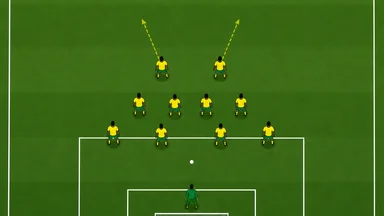
The introduction of SAOT will likely alter how teams approach offside traps and attacking runs. Under the current system, defenders can rely on the occasional late flag—a linesman raising the flag a split second after the pass, sometimes incorrectly. With automated offside, the flag is delayed until the system confirms the decision, meaning defenders can no longer count on a quick whistle to save them. This may force teams to adopt deeper defensive lines or more conservative positioning, as the risk of a perfectly timed run being caught offside is reduced.
For attackers, the change is liberating. Strikers can now time their runs to millimetre precision, knowing that the technology will accurately measure their position at the exact moment of the pass. This could benefit players who rely on speed and timing, such as those who frequently operate on the shoulder of the last defender. A study by football analytics firm Opta, released in 2024, analysed offside calls in the Bundesliga and projected that goals from offside-bait situations—where a striker deliberately hangs on the line to draw a defender—could rise by approximately 12% if SAOT is perfectly accurate. However, this figure is speculative, as it depends on how quickly teams adapt.
Set-piece offside traps may also become obsolete for attacking teams. Currently, teams often position attackers just offside to force the defending team to push up, then quickly drop back to receive the ball. With SAOT, those runs will be flagged automatically, removing the tactical ambiguity. Coaches will need to find new ways to create space, perhaps through more intricate movements or delayed runs. The high defensive line, a staple of modern pressing systems, may become riskier if the technology consistently catches attackers who time their runs well.
Not everyone is convinced the change will be positive. Some coaches worry that the millimetre precision will lead to a spate of marginal offsides that, while technically correct, feel unfair to fans. A striker whose heel is 2 cm beyond the line will be flagged, even if that margin has no practical effect on the play. This could lead to more goals disallowed for negligible margins, increasing frustration. FIFA has argued that consistency is more important than leniency, and that the system removes the randomness of human error. The debate is likely to continue into the tournament itself.
Lessons from Bundesliga and Serie A Rollouts
FIFA's decision to mandate SAOT builds on experience from domestic leagues. The Bundesliga introduced semi-automated offside in the 2023-24 season, using a system developed by Kinexon and Hawk-Eye. Over the course of that season, the league reported a 99.3% accuracy rate for offside decisions, with an average review time of 15 seconds. The system was particularly praised for its in-stadium 3D replays, which helped fans understand decisions in real time. Acceptance grew over the season as fans saw the technology reduce controversy.
Serie A followed in the 2024-25 season, implementing a similar Hawk-Eye system. The Italian league faced initial resistance from some clubs, who argued that the technology would slow the game. However, by mid-season, complaints diminished as the system proved reliable. One notable incident: a goal was disallowed for a 1 cm offside, sparking debate about the threshold for intervention. Serie A's response was to emphasise that the rule is binary—either offside or not—and that the technology simply enforces that rule more accurately.
Both leagues reported that the technology did not eliminate all offside controversies. In a few cases, the ball-touch timing was ambiguous—for example, when a player's foot brushed the ball but did not fully strike it. The system's algorithm must decide whether the touch is sufficient to start the offside clock. This grey area remains a challenge. FIFA's solution, trialled at the Club World Cup, is to use a force threshold: only touches above a certain acceleration count as a deliberate pass. This reduces ambiguity but may still miss some subtle touches.
The Bundesliga and Serie A experiences also highlighted the importance of fan communication. Both leagues invested in stadium screens that show the 3D offside animation, allowing fans to see exactly why a decision was made. This transparency has been credited with reducing crowd anger and maintaining the atmosphere. FIFA plans to replicate this at the 2026 World Cup, with all host stadiums equipped to display the animations within 30 seconds. Broadcasters will also receive raw skeleton data to create their own graphics, giving viewers multiple perspectives on each decision.
Counterarguments: The Case Against SAOT
Despite the technological promise, SAOT faces significant criticism. One major concern is the erosion of referee authority. Some former officials argue that automating offside decisions reduces the referee's role to a mere conduit for machine output, potentially undermining respect for match officials. Pierluigi Collina, FIFA's head of refereeing, has acknowledged this risk but maintains that the referee remains the final decision-maker for non-offside incidents, and that SAOT only assists with factual calls.
Another criticism is that marginal offsides, while technically correct, can ruin spectacular goals. In the 2025 Club World Cup, a goal by Manchester City's Erling Haaland was disallowed because his shoulder was 3 cm offside. The decision was correct, but many fans and pundits argued that such a tiny margin should not negate the skill of the build-up. This has led to calls for a "daylight" rule, where a player is only offside if there is a clear gap between them and the defender. FIFA has rejected this, citing the need for a clear, objective standard.
Cost is another barrier. The SAOT infrastructure—cameras, sensors, and processing units—costs approximately $1.5 million per stadium. For lower-tier leagues and smaller tournaments, this is prohibitive. Critics argue that FIFA's mandate creates a two-tier system where only elite competitions benefit from accurate offside calls, while grassroots and lower leagues rely on human error. FIFA has responded by offering subsidies to member associations, but the cost remains a concern.
Finally, there is the risk of over-reliance on technology. If a system failure occurs—such as a camera malfunction or sensor error—the fallback to manual VAR could cause confusion. During a Bundesliga match in 2024, a power outage temporarily disabled the SAOT system, forcing a return to traditional VAR. The match was delayed by 10 minutes, and the incident raised questions about redundancy. FIFA has addressed this by installing backup power and redundant camera arrays, but the possibility of failure cannot be eliminated entirely.
What This Means for Match Officials and Fan Experience
For match officials, the 2026 mandate represents a shift in responsibilities. Assistant referees will still raise their flag, but they are instructed to delay the signal until the automated confirmation arrives. This eliminates the "late flag" scenario where a linesman keeps the flag down for a marginal call, only to raise it after the attack develops. The new protocol is clear: the flag is a signal to the referee, not a binding decision. The referee will then wait for the VAR to confirm or overrule based on SAOT data.
This change requires trust in the technology. Some officials have expressed concern that the system could erode their authority, making them seem like mere conduits for a machine. FIFA has countered by emphasising that the referee remains the final decision-maker, especially for non-offside incidents. The technology supports, not overrules. In practice, referees will still manage the game, issue cards, and judge fouls. The offside decision, once the most disputed, will now be largely automated, freeing officials to focus on other aspects of the game.
Fan experience is expected to improve, though not without adjustment. Stadium screens will show the 3D offside animation within 30 seconds of the incident, providing instant clarity. Broadcasters will have access to the same data, allowing them to explain decisions without relying on pundits' interpretations. A survey conducted by FIFA during the Club World Cup found that 78% of fans felt the technology improved their understanding of offside decisions, though 22% remained skeptical about marginal calls. This suggests that while transparency helps, it does not eliminate all discontent.
The ultimate test will be the 2026 World Cup itself. No amount of trials can fully prepare for the pressure of a knockout match in a packed stadium. The system will be scrutinised for every decision, and any failure—a missed offside, a false flag—will be magnified. FIFA is aware of this and has built redundancies: backup cameras, manual overrides, and a dedicated VAR team for each match. Whether the technology becomes invisible or sparks new controversies remains an open question. What is certain is that the 2026 mandate will be watched closely as a model for the future of the sport.